BREAKFAST FOR CHAMPIONS by Guest Contributor, Sami O’Shaugnnessy

-- Please meet our friend, Sami. She is the busy mother of one and our resident tech expert. But Sami is also a trained chef with deep knowledge of nutrition and how to put things together to make delicious, healthy sense while keeping it simple. I hope you enjoy her contribution to our journey to less.
Nothing hits quite like that morning cup of coffee, and many a time, that dose of caffeine plus a grab-and-go granola bar is what carries us through our hectic mornings of battling traffic, sifting through emails, or hoping to the next appointment or meeting. Life is busy. The classic American, on-the-go mindset may be one of the greatest drivers of success, but often we fall short in recognizing the importance of nourishment.
According to Merriam-Webster, breakfast is defined as “the first meal of the day, traditionally breaking the overnight fasting period.” The term literally derives from “breaking the fast.” While there are varied opinions about breakfast timing, most will agree that the most important factor is not when you break your fast, but how you break your fast.
While nailing a solid breakfast routine is fundamental to setting yourself up for the day, it is often the most challenging. Convenience foods are easy. It’s easy to swing through Starbucks to grab a muffin along with your delectable latte. It’s easy to grab that strawberry-flavored yogurt cup. What doesn’t seem easy is establishing a breakfast routine that provides energy and essential nutrients to support metabolic function and contribute to overall daily nutrient intake.
The idea isn’t to demonize these treats—it’s accepting that they are treats. If you want to indulge, try pairing them with other fibrous, protein-rich sources of food to balance that dopamine kick.
I’m here to tell you that it can be simple. With proper planning, discipline, and a little extra time spent, you can establish meals that work for you, even in life’s busiest seasons. Even the smallest investment in nutrition offers the greatest returns.
“Breakfast is the most important meal of the day” may be one of the oldest, most cliché sayings, but it’s critical to understand what makes this so true. Our bodies respond to the inputs we provide. And while starting off the day with a bagel or a piece of fruit may seem harmless, that rapid spiking in glucose is not sustainable for steady energy throughout the day.
A Harvard-summarized study in the Journal of Dairy Science found that people who consumed 28 g of protein at breakfast had lower blood sugar levels and reduced appetite later in the day compared with those who ate only 12 g. Extra protein at breakfast helps control hunger (Harvard Health).
Building a plate with protein as the anchor, followed by fiber, complex carbohydrates, and healthy fats is the key to satiation, maximizing brain power, and avoiding that 2 p.m. energy crash. The tricky part is that most people fall into one or several of these categories: little to no appetite in the morning, no time or energy to throw together a balanced meal, or a false perception of what 30 g of protein actually looks like.
A common scenario may look like this: one might reach for two hard-boiled eggs, thinking this is healthy. Here is the macronutrient breakdown (per egg):
· Calories: ~70
· Protein: ~6 g
· Fat: ~5 g
· Carbohydrates: <1 g (essentially zero)
· Fiber: 0 g
While eggs (a very nutrient-dense food) include all nine essential amino acids and plenty of other metabolic benefits, two hard-boiled eggs equal only 12 g of protein. And while there is plenty of fat, we are missing carbohydrates that help with fullness and digestion, and we are completely lacking fiber.
We want all of these macronutrients to work harmoniously in one beautiful meal. A more balanced approach to breaking your fast will also offer a much higher micronutrient profile—especially when your meals (and snacks!) are comprised of whole foods.
Without going into detail about the many benefits of consuming a whole-food diet, one key advantage is exposure to a variety of colors. While Skittles may have trademarked the slogan “Taste the Rainbow,” I challenge you to use this phrase as a guide for your grocery checklist and for creating simple, yet tasty recipes.
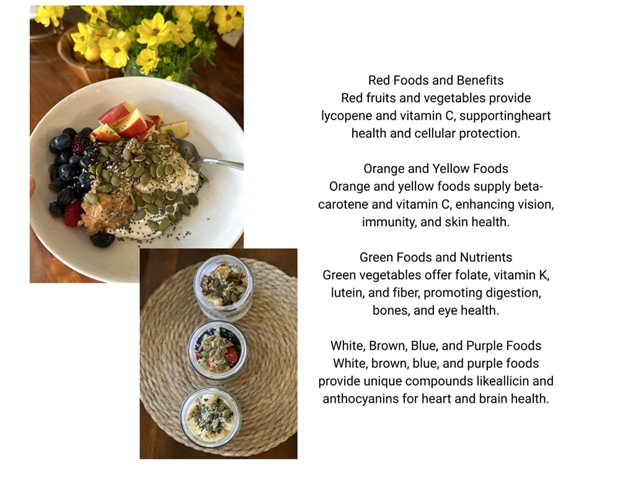
Below are some of my favorite protein-forward, balanced breakfast recipes for both on-the-go days and days when you have a little extra time to spend in the kitchen. I’ll break down what vitamins and minerals these colorful foods offer. And don’t worry, there are options for a savory fix or to satisfy your sweet tooth.
Basic Overnight Oats
(Can be made dairy-free or with dairy for an even higher-protein option)
Serving size: 3 jars or containers
Ingredients
· ½–1 cup oats (depending on how thick you like it)
· 1 Tbsp chia seeds
· 1 cup milk of choice
· ½ cup plain Greek yogurt (fat content of choice)
o If using dairy-free yogurt, you may need to add protein powder to compensate for the lower protein content
· Optional:
o 1 tsp sweetener of choice (honey, maple syrup, monk fruit)
o Vanilla extract
Instructions
Mix all ingredients in a bowl. At this point, you can portion into containers, or cover and refrigerate for 2 hours to overnight and portion later.
When serving, add a little extra milk or water to reach your desired consistency.
Recommended Toppings
(To add fiber, carbohydrates, and healthy fats)
· Berries
· Banana
· Chopped apple (or baked apple for an apple-pie flavor)
· Seeds: pumpkin seeds, hemp seeds
· Chopped nuts or nut butter
· Cocoa nibs
Tip: While this works as a full serving, I also love making a yogurt bowl and adding a portion of overnight oats as a layer.
If this recipe still feels too involved, my go-to is a Greek yogurt bowl with plenty of toppings. You can add heartier options like protein bar bits or cookie bites, or granola—just be mindful of sugar content. My favorite is Purely Elizabeth.
Egg Bake or Egg Bites
You can scale this or eyeball-it, it’s that simple!
Base
· ~8–9 large eggs
o (Sometimes I use fewer whole eggs and supplement with liquid egg whites)
· 1 cup cottage cheese
Add the Colors of the Rainbow
· Veggies: mushrooms, bell peppers, tomatoes, shaved sweet potatoes, etc.
· Greens: spinach, arugula, kale, or herbs like basil or chives
· Seasonings: salt, pepper, garlic powder, “Everything but the Bagel” seasoning
· Cheese: feta, sharp cheddar, etc.
· Meat lovers: cooked chicken sausage (I love Bilinski’s Italian Mushroom & Herb or Amylu’s breakfast sausage), ground turkey, ground beef, or leftovers from another meal
Instructions
· For firmer bites, use closer to 8 eggs; for a more delicate, fluffy texture, use 9.
· Whisk the eggs and cottage cheese together and season to preference.
· Lightly grease a muffin tin with oil or butter and fill each cup about halfway.
o Do not overfill—the eggs will puff up!
· Add toppings evenly to each cup.
· Bake at 350°F for ~20 minutes. Ovens vary, so check for doneness. Once the edges are set and the center is firm to the touch, they’re ready.
Alternative: You can also whisk everything together and bake in a 9×11 pan (or whatever size you have on hand), then portion after baking.
The key is ensuring that whatever you decide to fuel yourself with, you’re fueling with enough food. For example, two egg bites alone may not be satiating—add healthy carbohydrates like fruit or a slice of sourdough toast. One of my favorite carbohydrate sources to keep on hand is baked Japanese Murasaki sweet potatoes, seasoned with flaky salt and a dash of cinnamon.
Additionally, while the recipes above are more “traditional” breakfast items, you by no means need to stick to breakfast foods. I often create random breakfast bowls with leftover vegetables and a cooked protein source—and those end up being some of the most delicious meals.
Eating healthily shouldn’t be stressful, but a plate should be built with intention.
Simplicity is sustainable, don’t overcomplicate it!