Digesting is hard work . . .
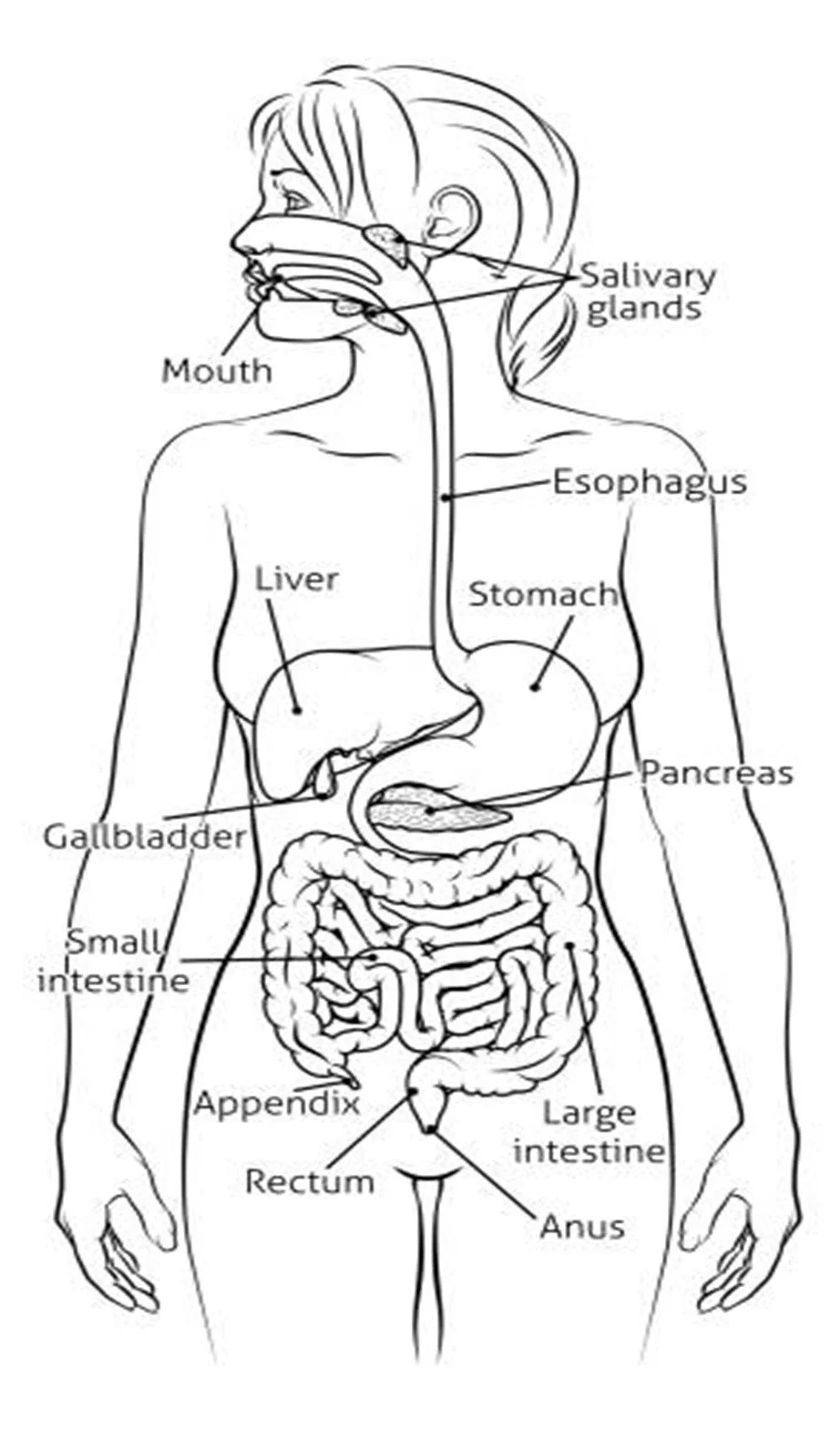
Have you ever wondered what happens to food once it passes out of your mouth and down into that maze of stomach and other organs? Ew, not a really pretty picture given how the waste byproducts of our food intake come out. But, to understand nutrition and how the body uses food, I think it’s important to understand the digestive process. For most of us, this amazing system is around 30 feet long. It begins in the mouth, passes through the esophagus (about 10”), the stomach (about 12”), the small intestine (about 22 FEET), the large intestine and rectum (another 5 feet), and ending at the anus (1 to 2”). Imagine how many twists and turns all of those organs have to go through to fit into the abdominal cavity!
Digestion in humans is a complex series of actions with different parts of the body performing different functions. The ultimate goal is to convert food into energy. But that conversion process requires all parts of the digestive system to work together. If any single organ or step in the process is not functioning properly, the whole digestive process can slow down or even come to a grinding and potentially painful halt. Let’s start at the beginning and put all of the pieces together.
Digestion begins before you take that first bite. Once you get a whiff of food (cookies baking in the oven) or catch sight of a yummy bite (picture a pastry in the window of your favorite bakery), your body reacts by producing saliva. What is saliva? Here’s a handy AI-produced definition that’s quite fascinating.
Saliva, or spit, is a watery fluid produced by salivary glands in the mouth, composed mostly of water (99%) but also containing enzymes, mucus, proteins, minerals, and electrolytes, crucial for moistening food, aiding chewing and swallowing, beginning digestion, neutralizing acids, and protecting teeth and gums from decay and bacteria. It acts as a natural mouthwash, cleaning away food particles, and contains compounds that strengthen enamel and fight germs, preventing infections and bad breath.
Production of adequate amounts of saliva is one of the reasons it’s so important to consume at least 64 ounces of water daily. (See the “Water, Water Everywhere” blog for more information on the “right” amount of water.) So, digestion starts in the mouth with the tongue, teeth, jaws and saliva working together to begin breaking down our food. Keys to success in this first step include adequate hydration for maximum saliva production and chewing every bite thoroughly so the food can travel smoothly to the next destination.
Next step on the journey is the esophagus where muscle waves called peristalsis move the food down into the stomach. Now unlike cows who have four stomachs, humans have only one stomach. This simplifies the digestive process a lot!
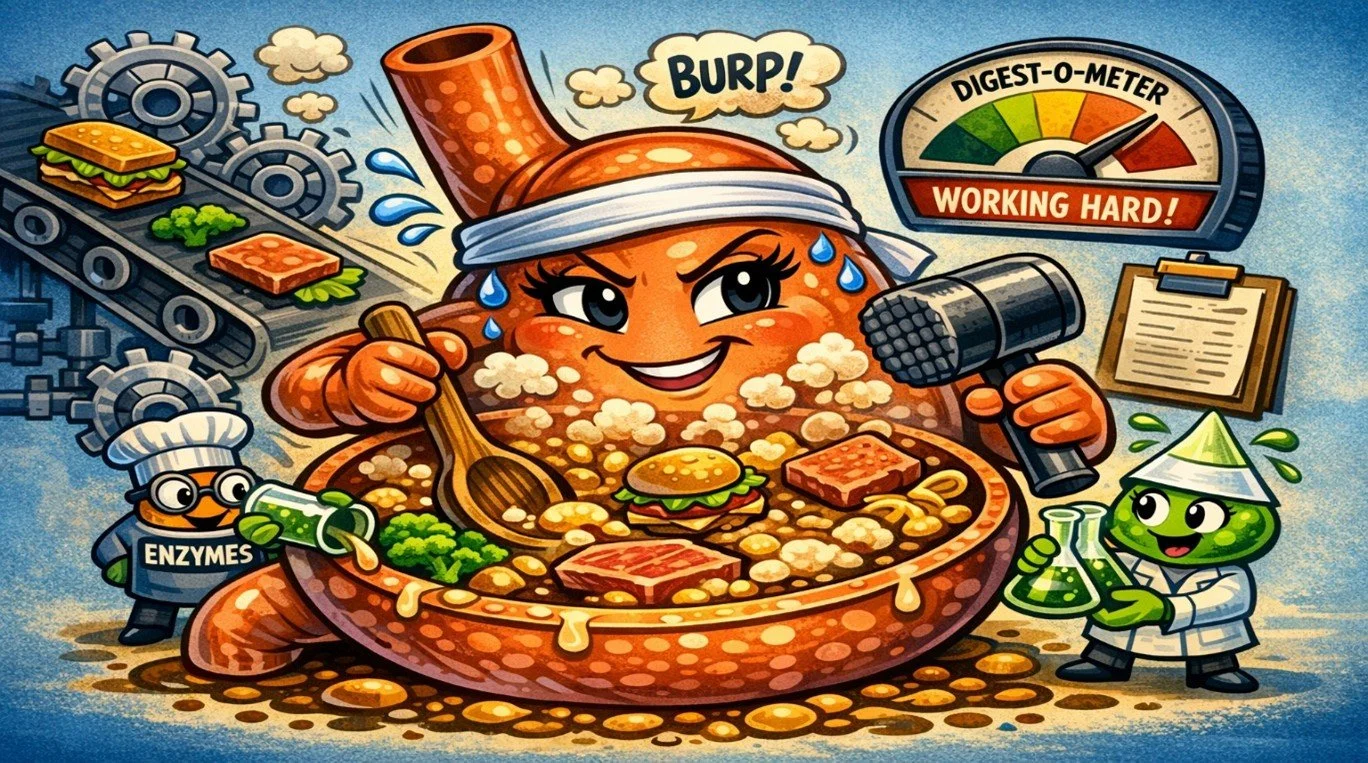
Your stomach is a muscular bag that acts to store food and produce both digestive enzymes and hydrochloric acid to continue the digestive process that begins in your mouth. The stomach is located on your left side just under your diaphragm. At the entry to the stomach is the lower esophageal sphincter. Think of it as a gate keeper that opens to let the food in and then closes to keep it in. If it is weak or doesn’t operate correctly, you’ll get a back flux causing discomfort like heart burn. If you think yours isn’t working right a visit with your medical expert is definitely in order.
In order for your stomach to do its job, it has to maintain a delicate balance of hydrochloric acid (HA for short); digestive enzymes; and mucous. The hydrochloric acid’s job is primarily to destroy harmful microorganisms in your food. They’re kind of like palace guards whose job it is to prevent the bad guys from going where they can cause harm. Digestive enzymes start to break down the complex food components into simpler ones. There are a lot of scientific terms for that part which I’m going to skip. And lastly, we have mucous. Given how diligent the HAs are at their destruction, the thick mucus stomach lining is critical. The HAs we produce in our stomach are so strong they could literally melt the rest of your body if not properly contained! So, let’s be thankful that the mucous lining is constantly on guard.
What’s a major component of each of these 3 things? Water. You have to have enough water to allow the body to produce all of these but especially the HA and mucous. And, there’s a delicate chemical balance between hydrochloric acid, enzymes and mucous that must be maintained. Happily, most of us seem to be able to do that without outside help.
The stomach muscle walls contract and relax in tiny movements (peristalsis) that help your digestion along. Simple carbohydrates are broken down the fastest - with protein and then fat coming in 2nd and 3rd. One if the reasons you can get hungry quickly after a meal with only simple carbs is they get broken down so rapidly. At each meal, you need a balance of simple carbs for a quick energy boost plus protein and fat for prolonged production of energy. The balance of these 3 with each meal is a key to keeping sustained energy for longer periods.
Once food moves out of the stomach, the next phase is in the small intestine. This is where the pancreas, the liver, the gallbladder and the intestine all produce various digestive juices to continue to break down the food. Like the stomach, the small intestine uses peristalsis to move the food through the system and to mix it with digestive juices. As we age, these muscles gradually slow down so it takes longer to properly digest food. This is one of the reasons many of us experience slow weight gain as we age. The longer food sits in this area, the more calories we absorb.
The small intestine lining is covered with countless little projections called villi. The purpose of villi is to increase the surface area of the small intestine to help absorb more nutrients. As they wave back and forth during peristalsis (think of the movement of waves in the ocean), they encounter the digested food and absorb the nutrients into our blood stream. I read that the total surface area of the digestive system if laid out flat would cover ½ of a badminton court! That’s roughly 400 square feet.
The large intestine comes into play as the recipient of the waste products from our food. Water is absorbed from this waste material as it passes through the large intestine. If food waste goes through too quickly, it will come out just as fast. And, if the food waste goes through the large intestine too slowly and too much water is absorbed constipation can result. In certain cases, slow movement through the large intestine can result in a painful and potentially harmful blockage. My husband, Tim, has experienced this problem recently and ended up in the hospital! This is one of the reasons that the right amount of fiber and water are so critical.
The large intestine has its own environment to do its job. It contains microbes (bacteria) that dine on the leftovers from the small intestine. These microbes produce gas that sometimes builds up and has only one exit strategy. You get the picture.
Once food waste hits the large intestine, you can figure on around 30 hours before it is excreted. At the very end of the large intestine is the rectum which stores solid waste and lets you know it’s time to go. From mouth to out, the process can take 2 to 4 days. Shorter time periods for simple carbs and longer time periods for protein and fats.
At this point, you may be reflecting that you were familiar with most of this but here’s something you may not have heard of. Surrounding and supporting these important body parts is something called the mesentery. The mesentery is in organ shaped like a fold of tissue in your abdomen that anchors the intestines to the abdominal wall, providing structural support, carrying vital blood vessels, nerves, and lymphatics, and playing a key role in immune responses, fat storage, and connecting digestive organs. It’s not just tissue; it’s an entirely distinctive organ that is essential to keep everything in place so they can function properly. If you’ve experienced stomach pain that no one can figure out, ask whether the mesentery might have a role. It’s also essential in triggering immune defense reactions. The Mesentery is one of those heroes or villain organs that most of us haven’t even heard of. Be thankful if yours is working well because in human history, no one has ever survived without the mesentery!
When I reflect on the many parts of the digestive system, I am a little awed by how complex this everyday function really is. In a future blog, I think it will help to go a little deeper into the whole issue of prebiotics, probiotics, and that delicate balance of acids and enzymes required to keep us healthy.
As I journey to less, knowing more is one of my keys to making it better.