10,000 Steps A Day – Good Guide?? – It depends on your age!
I consider myself to be a somewhat fit person. I do a walk or workout of some kind a minimum of 4 days a week. I’d like to do more, and I think I should probably do more but given my time demands, I’ve given myself permission to be satisfied with 4 workouts a week.
In conversations and in some of my reading, I’ve frequently encountered the statement that a person should try to hit 10,000 steps a day to have good cardio health, muscle tone, weight maintenance, blah blah blah. Now, if you’re a runner that step count is probably easy. For someone who runs 5 or more miles an hour, you can hit a 10,000 step count in about an hour. No problem…
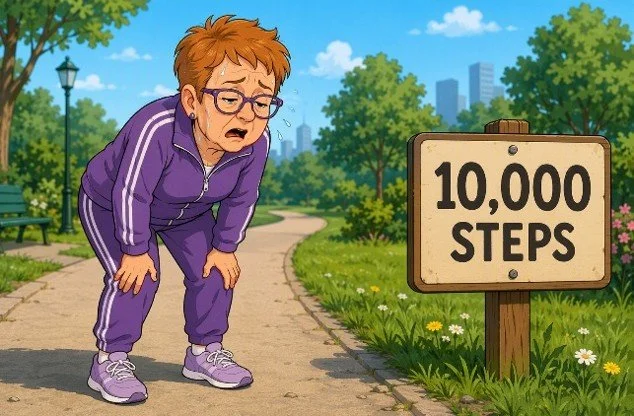
But for us older ladies who prefer not to punish our joints with running, 10,000 may not be realistic as a daily goal. I question if it’s even healthy unless running is something you’ve done all your adult life. Studies have shown that for older people, the benefits of walking come at a much lower daily step count.
To help me track some of my health numbers, I recently bought an inexpensive smartwatch. It tracks steps, blood pressure, heart rate, sleep and some other things I haven’t quite figured out yet. The watch has a sleek black face and pink adjustable band which I’ve found to be surprisingly comfortable. I didn’t think I would like to wear it at night to track the quality of my sleep, but I hardly know it’s there, so it has not been an issue. The information is fascinating.
Back to the issue of 10,000 daily steps … I am just over 5’6” tall. My stride length is between 2.2 and 2.5 feet per stride. If I walk slowly with a stride length on the shorter side, I will have to walk 4.2 to 4.5 miles a day to reach 10,000 steps. At a speed of 3 miles per hour, that’s an hour and thirty minutes of walking to hit 10,000 steps. It’s unrealistic for me to do that every day. Please – don’t let those numbers discourage anyone from going for the 10,000 goal! It’s completely doable for our younger friends!
According to heart.org, the American Heart Association presented the findings of a study done by the University of Alabama’s Birmingham School of Public Health. They used daily steps as an easy way to measure physical activity. They observed that if someone’s step count increased from only 2,000 per day to 4,500 per day, it lowered the risk of a “cardiovascular event” by 77%. For people over the age of 70, walking an additional 500 steps per day (only ¼ of a mile) lowered the risk of heart disease by 14%. You can see a summary of this comprehensive study at https://newsroom.heart.org/news/for-older-adults-every-500-additional-steps-taken-daily-associated-with-lower-heart-risk.
Bottom line is something we all know. Movement at every age is beneficial to our health. Measuring steps is an easy way to keep track of our daily activity. For a healthy woman my age the goal of 6,000 to 8,000 steps per day seems to be an appropriate one according to a variety of sources I studied. Yesterday, I did no walking, and my step count was only a little over 3,000. That’s defined as “sedentary” and given I spent much of the day sitting at the piano (for church choir) or napping or driving in my car, I can tell you it was definitely a busy, but sedentary day. The day before that I spent 45 minutes on the treadmill with a 5% incline at 3 miles per hour. I managed to get my step count for that day to almost 8,000 but just a bit short. I think 7,000 is going to be my personal daily goal.

What does that mean in terms of caloric burn? On a flat surface, walking a mile burns about 80 calories for someone my age and weight. By increasing the incline to 5%, the caloric burn increases to about 132 calories. That’s an extra 52 calories per mile. I’ll take it! The increase in incline means my hamstrings, glutes and calves have to work harder but without the increased impact from jogging. It also pushes my heart rate into a better fat-burning zone. With some great music pulsing in my ears, the time goes quickly. My goal is to have 2 Pilates workouts, 2 gym workouts and at least 1 MMA workout each week. That daily step count is a good guide, but it’s not cast in concrete as the smartwatch doesn’t accurately measure things like Pilates, weightlifting, etc.
Bottom line for the daily step count is this … do what fits you best. Your age, weight, personal goals, fitness, lifestyle … all of these matter when setting your personal goals. Whatever you do, just remember that every step can be a step towards a healthier, happier you!