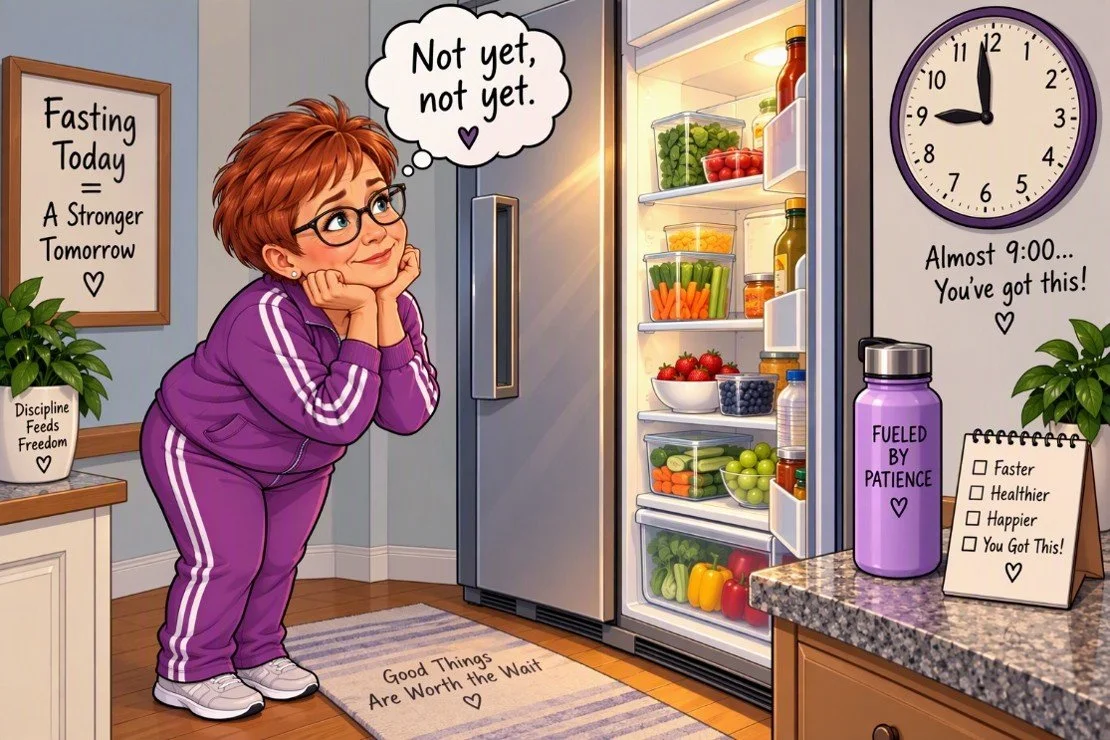
In recent years, the concept of fasting or intermittent fasting for better health and “easier” weight loss has been part of many conversations. If you think about it, most of us fast overnight perhaps without even thinking of it as a fast. For example, if you finish your food intake around 8:00 pm including that after-dinner snack and then have breakfast around 7:00 am the next morning, that’s an eleven hour fast. Is it worth it to try to extend that period of fasting? Let’s think about what happens during any period when we’re not eating
When our bodies need energy, we first utilize glucose from recently consumed food. After about 12 or as much as 24 hours with no new intake of food the liver exhausts its store of glucose. Once that’s gone, the body switches and begins to break down body fat (lipolysis) to release fatty acids into the liver which then converts them to ketone bodies. Ketones are actually a source of clean energy for our brains and muscles. Ketones are quite an efficient source of energy and can help clear brain fog. Many people who fast report they actually begin to feel better after 12 or so hours of fasting. Studies show that what I’m going to call smart fasting has been shown to reduce inflammation and accelerate healthy cell replacement. This process of shifting from energy from recently consumed food to energy from body fat is called metabolic shifting.
Before I did some research on fasting, I thought that short-term fasting might decrease metabolism. To me that made sense from an evolutionary standpoint. Why wouldn’t our bodies try to preserve fat by lowering our caloric consumption as a defense mechanism hearkening back to that period in our history when meals were unpredictable? As it turns out, a short-term fast can actually give your metabolism a temporary boost, resulting in a small increase in caloric consumption.
Let’s explore different types of fasting to understand their impact.
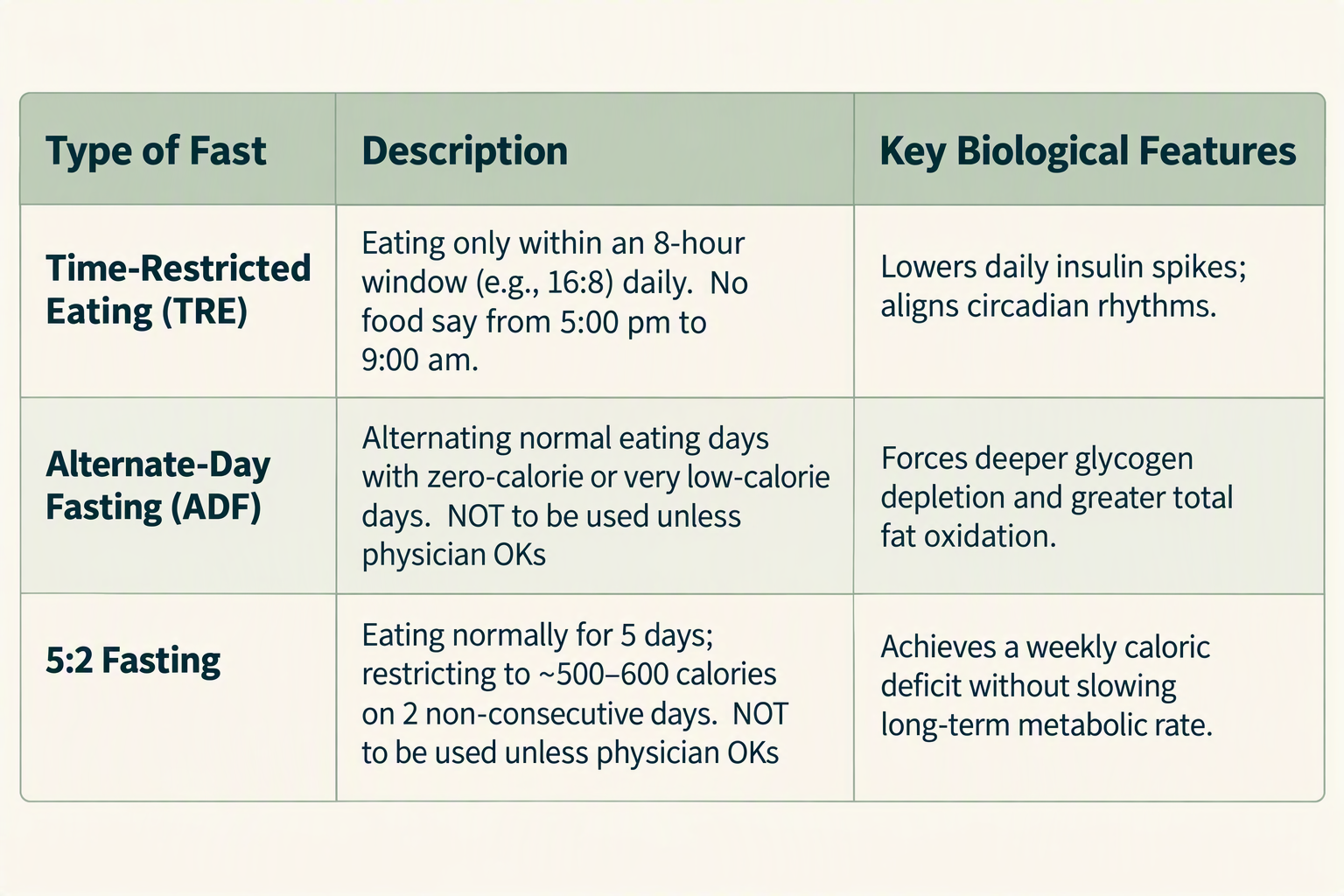
During the first two types of fasting (TRE or 24-hour fast), your metabolic rate will actually go UP by as much as 14%. This is because our hormones kick in to release Epinephrine (AKA adrenaline surge). This helps our bodies to break down stored body fat . In addition to the adrenaline spike, our noradrenaline levels go up which act as a signal to the body to increase activity at the cellular level and go to those handy fat stores for energy. And thirdly, the human growth hormone, HGH, also spikes during this type of fast which helps to preserve lean muscle mass.
All of this makes sense if you think about the need for additional mental clarity and energy if we had to go out and hunt for our food. Luckily most of us don’t need to do that now but our bodies have retained that physical reaction meaning our metabolism goes up during these short fasts. This boost will last up to 48 hours.
After that time, our bodies go into survival mode. Hormones, core body temperature and BMR (basal metabolic rate) all go down once our bodies realize that no food is coming in and it has to get seriously protective. I know of people who have done medically supervised 72 hours fasts but there’s no way anyone should go that route alone. It’s an extreme measure and too many things can go wrong.
Let’s reflect for a moment on the difference between continuous calorie restriction and intermittent fasting. For someone who has a low caloric intake every day over time, the result will be a decrease in metabolism meaning it’s much harder to lose weight. This may be why I got stuck at 155 pounds for so long. Perhaps (this is just a guess), my metabolism adjusted to my lower daily calorie intake and my body became a more efficient consumer of calories?? I haven’t experienced a noticeable decline in energy but perhaps I haven’t been paying enough attention. That’s certainly something I’m going to think about. Based on the research I’ve done, I am going to shift my pattern of eating so that I follow the 16/8 Time Restricted Eating described above. By experiencing that metabolic shift daily, I hope can consume the same number of calories, but by just slightly increasing that metabolism my weigh loss journey will continue. I believe I’m also slowly adding more muscle mass so that more than likely accounts for this long plateau I’ve been on for a few months. As we all know, muscle burns more calories than fat so converting fat to muscle may not reflect in a positive way on the scale, it will definitely reflect positively on overall health and wellness.
So, what’s the bottom line on fasting? Based on the research I’ve done (pulled a wide variety of resources including Harvard Medical and Johns Hopkins) I believe that a 16/8 pattern of eating is worth a try. I strongly believe any other form of more drastic fasting should only be done with the approval and guidance from your medical professionals. A reality check says I won’t be able to observe the 16/8 guideline every day, but I’m going to try it as often as I can! Wish me luck and more progress on my journey to less!