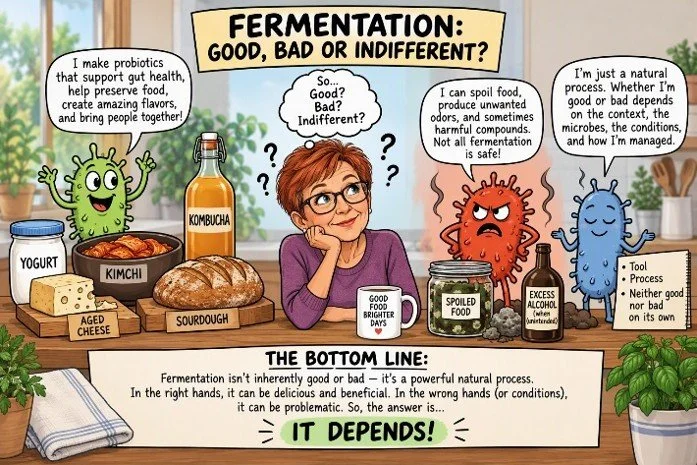
When the word “fermentation” comes to mind, I think of something that has gone bad, really bad with the accompanying odors and slime. That probably comes from growing up on a farm and seeing the result of bad fermentation in some of the grains we stored to feed the livestock. But fermentation is actually a natural process that can lead to a fantastic outcome. Transforming grapes into wine, for example, is a great example of beneficial fermentation.
When it comes to our wellness, fermentation has come to the top of the list in recent years as a source of important nutrients for the bacteria in our guts. In a recent article by Amy Bieber, MS, MPH of Cedars-Sinai she writes “Fermented foods offer a simple, delicious way to boost your gut health and overall wellbeing. ….turns out the process of fermentation confers powerful health perks.”
Let’s start with what fermentation is from a scientific standpoint. In its “simplest” form, fermentation is a metabolic process where microorganisms like bacteria, yeast and molds break down organic substances into simpler compounds. In nonscientific terms, which means in essence that these tiny live microbes eat the sugars and starches in food and then transform them into something else like alcohol, acids or gas. Fermented foods produce both probiotics and postbiotics which can crowd out harmful microbes.
Word of caution, if you start to add fermented foods to your diet, start very slowly! The last thing you want to do is overload on kimchi or kefir and wind up with a painful buildup of excess gas. Moderation, moderation, moderation … and diversity … those are keys to being smart about adding this important component to our diets. What we’ve learned more recently is how important fermented foods are in getting the most out of our food. This process completely transforms the nutritional profile of certain foods and creates a positive ripple effect on our digestive health.
Live probiotics may be contained in naturally fermented foods or can be added later to give fermentation a boost. However, be aware that not all fermented foods contain active, live cultures. Most microbes are sensitive to heating, processing and alcohol. This means that even though wine and sourdough bread have live microbes at the beginning, the heat or alcohol produced usually wind up killing the good stuff. And, anything in a can or jar will not likely contain live microbes. It doesn’t mean that inactive or dead microbes are without benefit. They actually can help our gut health so go ahead and enjoy that fabulous sourdough roll with a glass of red wine and maybe a bit of cheese. (Assuming your diet doesn’t restrict consumption of these foods, of course!)
Why this focus on fermented foods? In part because they can help create diversity in our gut health. If a diet does not include enough diversity in the types of food we eat, our guts will be unable to produce all the healthy bacteria we need to get the most nutrition out of our food and to fight off disease and inflammation in our systems. Even inactive microbes can help because the chemical byproducts in the fermentation process will stay in the food and once they arrive in our guts can interact with our immune cells and gut barrier to help fight off the bad bacteria. Some smaller studies have also shown that inflammatory proteins can be reduced with the consistent ingestion of moderate amounts of fermented foods.
What are some “good” fermented foods? hint … look for the words “naturally fermented”
Kefir and Yogurt – read the label to avoid heavy sugars and find live or active bacteria
Kimchi – some people are huge fans. I’m working on it.
Kombucha
Miso
Natto (ugh, not going there, sorry! This is sticky, fermented whole soybeans. Very popular in Japan. I’ve had it. I’ll pass, thank you.)
Sauerkraut – preferably not the kind in a jar or can
**NOT mass-produced pickles. These are made with vinegar and soaked in acid rather than naturally fermented. They might taste great on your sandwich but don’t look at them as a source of good fermentation.
Here’s a recipe for escabeche (pickled vegetables) I borrowed from Harvard Medical schools’ recent article on fermented foods.
2 cups filtered water
1 to 1-1/4 tablespoons sea salt 2 tablespoons apple cider vinegar
1 jalapeño or a few small hot chiles (or to taste), sliced
1 large carrot cut into 1/4-inch-thick rounds or diagonal slices
1 to 2 cups chopped cauliflower or small cauliflower florets
3 small stalks celery (use only small inner stalks from the heart), cut into 1-inch-long sticks
1 bay leaf 1 cabbage leaf, rinsed
Warm the water (no need to boil). Stir in the sea salt until it dissolves completely. Set aside to cool (use this time to cut the vegetables). Add the vinegar just before using. The brine can be made ahead of time and stored in a sealed glass jar on the counter to use when ready to pickle.
Set a quart-size canning jar in the sink and fill it with boiling water to sterilize. Empty the jar and tightly pack the vegetables and bay leaf inside to within 1 to 2 inches from the top of the jar. Pour the brine over the vegetables to fill the jar to within 1 inch from the top. Wedge the cabbage leaf over the top of the vegetables and tuck it around the edges to hold the vegetables beneath the liquid.
Set jar on the counter and cover with a fermentation lid. (Alternatively, use a standard lid and loosen it a bit each day for the first few days, then every other day, to allow gasses to escape.) Let pickle for three to five days, depending on the indoor temperature. Check the taste after a couple of days, using clean utensils. Vegetables will pickle faster in warmer climates. Make sure the vegetables stay packed beneath the level of the liquid and add salted water (2 teaspoons sea salt dissolved in 1 cup warm filtered water) as needed.
When the vegetables are pickled to your liking, seal the jar with a regular lid and refrigerate. Vegetables will continue to slowly pickle in the refrigerator. They will keep for about one month. Taste for saltiness before serving and, if desired, rinse gently to remove excess salt.
Calories: 1 (per 1 tablespoon)
Carbohydrate: 0 g
Protein: 0 g
Fat: 0 g
If you’re just starting to add fermented foods to your diet, start with one serving a day and very small quantities. Experiment to see what feels good and know that daily consumption in moderation will help with a successful outcome. As always, if you’re on any medication prescribed by a physician, consult your medical professionals before changing your intake of fermented foods. While I’m never going to be a fan of natto, I do love yogurt and kefir and I’m going to give the other foods listed above a try. Here’s to trying new things for better health!