If the shoe fits, wear it and walk (or run) in it with comfort and joy…
Co-authored by Priscilla Brehm and Dr. Roberta Brehm, PT, DPT, Board Certified Orthopedic Clinical Specialist
Introduction by Priscilla --
In an earlier blog, I talked about the importance of having good shoes for walking. While I’m certainly not a shoe expert, I can share with you what I’ve learned in the hope it might help you find a shoe that not only fits but helps encourage you to move more.
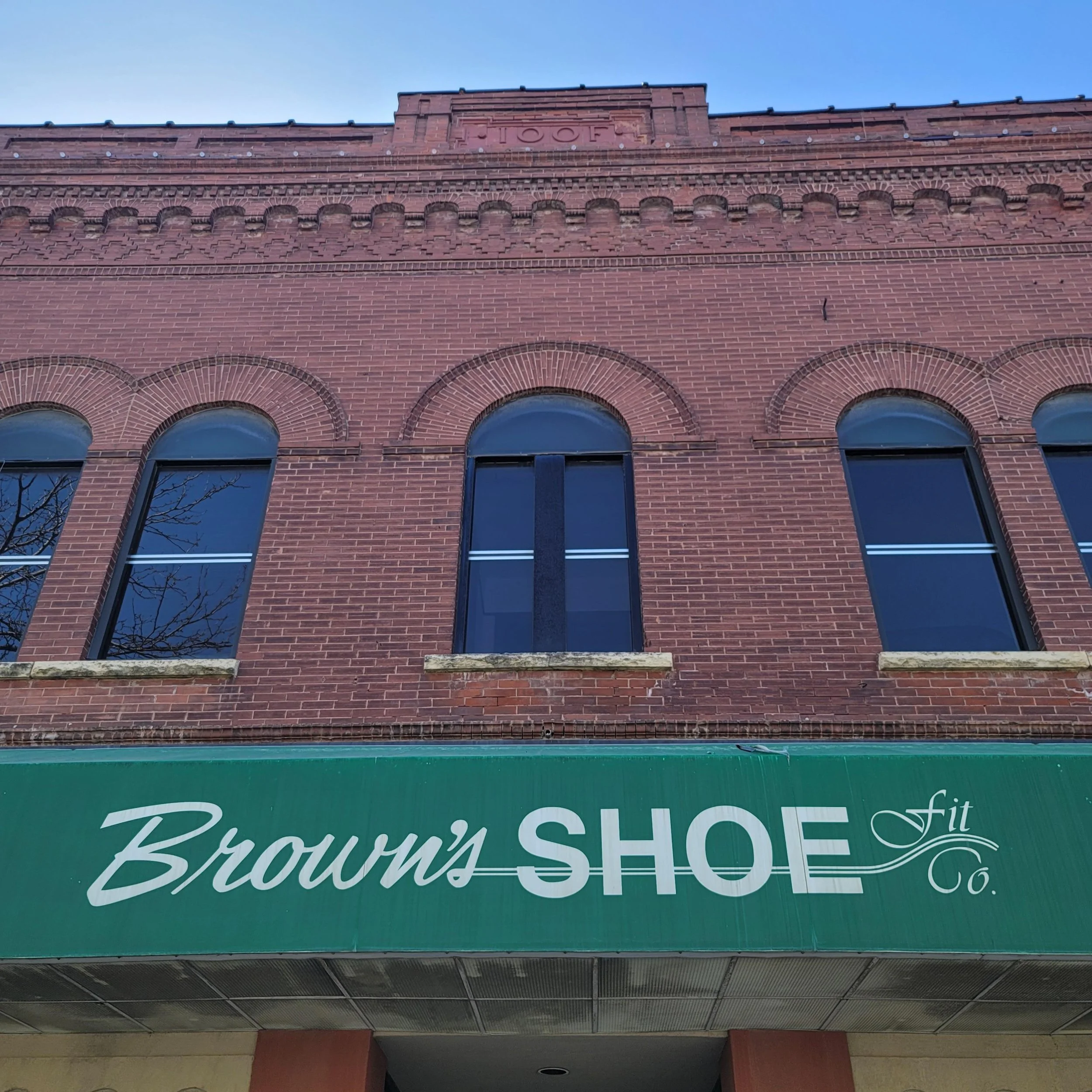
Thinking back to my childhood, I remember the importance my parents placed on good shoes. Every fall my family drove from our farm in northwest Iowa to the nearby town of Spencer to buy school shoes. Our destination was Brown’s Shoe Store. (See the photo below! I just happened to be visiting Spencer and captured this image.) I remember there was a giant machine we would step onto that “magically” showed how our feet fit in various styles. Radiation, anyone??
Those shoes had to last many months, so we made sure there was plenty of room in the toe box.
As an adult I think of shoes as a cultural necessity since going barefoot into an office or theater is generally not acceptable social behavior. That said, I do love to go barefoot. When it’s safe, barefoot walking can be quite beneficial.
This section is Co-authored by Priscilla & Roberta:
Without the structure and support of shoes our feet must do what they were designed to do. The entire foot must work to keep us erect and moving forward. Toes, arch, and ankle all must function in concert. By going barefoot, we can strengthen each of the parts of our foot and ankle that are so important as we go through all ages.
As we age the muscle mass in our feet and legs declines and ligaments become less elastic. All of these can contribute to weakness, balance issues, and pain, causing us to move less.
To strengthen our feet at any age of life it can be helpful to do (1) balance training and (2) foot and ankle strengthening. As with any form of exercise, proper technique matters. Many of these exercises involve instability so safety is important -- use protective measures like holding onto a stair rail as needed. Before you add this to your fitness regimen, please consult a qualified physical therapist to determine what, if any, foot exercises are appropriate for you.
Walking is complex. It can feel like “controlled falling”, but it requires coordination across the entire body. Let’s break it down.
A healthy walking gait is different for everyone, depending on anatomy, mobility, and medical history. If you’ve had surgeries or neurological conditions -- you can still have an efficient, healthy gait for your own situation.
All walking involves common phases. First, the gait cycle on one limb is divided into two phases: stance (foot is touching the ground), and swing (foot is off the ground). Let’s follow one limb through one gait cycle:
Stance: (foot on the ground)
1) Initial contact – for many of us, this begins at the heel. In others it might mean heel and midfoot together or even a completely flat foot. There is almost no weight on the foot in this part of the stride. This is the first part of the “stance” phase.
2) Loading Response - Your weight then beings to shift onto the forward leg.
3) Midstance - Weight is completely on this limb. This stance is why good control in a single leg balance is so important. Limited balance in midstance in one leg can create a lot of problems for the gait cycle on the opposite leg.
4) Terminal Stance - Hell lifts, weight moves forward over the forefoot. Traditionally requires extension (bending) of the toes, but this can be limited with certain foot surgeries and conditions.
5) Pre-swing - Final portion of stance phase, toes help propel the body forward transitioning into swing on this side.
Swing:
Initial Swing – Swing leg is behind the body and is not touching the ground. Foot leaves the ground.
Mid-swing – Swing leg is next to the stance leg.
Terminal Swing - Final phase of swing, leg is ideally in front of the body, preparing for initial contact.
Breaking it down, you can see that while walking seems natural, it’s actually a somewhat complex process to do properly. In each phase, every joint from the ankles to the upper body has a certain position it needs to be in, and every muscle has a different job. The arm swing, torso position and breathing are all parts of healthy walking.
It gets even more complicated when we consider that gait cycles of the two limbs have an effect on one another. For example, if someone has problems with their single leg balance, they won’t have good control in their midstance, which means they have to change and shorten the mid-swing phase on the opposite limb as compensation.
Now, about walking shoes – what should we look for in a good walking shoe? In general, we want a shoe that helps the foot but doesn’t do the work the foot should be doing! We don’t want lazy feet!
1) Generous toe box – It’s important that when trying on a walking shoe you try to spread your toes in the toes box to see how much room you have. Some toe boxes are oval in shape, but this is likely more restrictive. Other toe boxes look more like a fan which, when you look at your bare foot, is a more natural shape. Ideally, you don’t want any part of your toe to touch any part of the shoe when you’re either standing still or moving. It may be necessary to step up to a half or full size to get enough room for your toes.
2) Cushioning – Thicker cushions can be helpful in absorbing impact. This can be good for someone who has a foot injury or if their life involves standing a lot on hard surfaces. However, cushioning reduces the foots ability to sense the ground. Using high cushion shoes extensively can lead to problems with balance and foot sensory connections.
3) Heel height – (AKA “DROP”) – Higher heel drops reduce ankle motion and calf demand. This can make walking easier but can also lead to ankle stiffness and calf weakness over a longer period of time. A zero-drop shoe will generally be the healthier option but can require some adaptation.
4) Flexibility–A good walking shoe should bend where your foot bends, most at the ball of the foot. Try twisting and bending a shoe to see where it gives and where it is stiff. Too much stiffness can interfere with normal walking mechanics.
5) CAUTION – WARNING – READ THIS!!! Caution – if you’re used to a high drop, high cushion, inflexible shoe don’t immediately go to a minimal shoe. Your foot needs a gradual transition to strengthen and improve its mobility so that minimal shoe does not cause injury. This should ideally be supervised by a physical therapist.
6) Breathable upper material – During a long walk, feet tend to get sweaty so having a lightweight upper material can help keep your feet dry.
7) Arch support – Feet vary widely. Some people benefit from more support. For example, I have a very high arch, and my husband’s feet are almost flat. I need lots of arch support in my walking shoes to prevent a painful outcome. However, I recognize that arch support is not a substitute for making my foot arch muscles work so I balance my high arch support shoes with lots of barefoot walking when I can.
8) Visibility – If you walk a lot at night or in low light, try to find a shoe with a reflective strip on it. This is something that can be added, but it’s nice if it’s already built in.
Final Thoughts -- All of these things come at a price. Good walking shoes are an investment in your health. When you’re in the store, take your time. Walk in the shoes, find some stairs or an inclined surface to see how they feel. It’s especially important to check the fit on a downhill slope. You don’t want any portion of your toe to rub against the front of the shoe on a downhill. Some lacing techniques can help but it’s best if you don’t try to compensate for a poor fit with lacing techniques.
Unfortunately, many shoe salespeople don’t have proper training or understanding of what makes a good walking shoe for any particular individual. Bottom line, take your time and find a shoe that fits YOU and your unique needs.
Be sure you’re wearing good socks so you can assess the fit of the shoe. I like socks made of Smartwool. They provide extra cushioning; they wick moisture away and you can wear them more than once if needed before washing. Merino wool has moisture-wicking, antibacterial and odor resistant properties even with extended wear.
My current favorite walking shoe is the Ghost by Brooks. It’s lightweight, provides me with great arch support and I can walk or stand in them with no foot fatigue at all. I’m heading for REI to pick up another pair soon!
Ultimately, the best shoe is the one that fits you well, feels good, and helps you stay active. Take the time and make the investment in a healthier, happier you! Keep On Walking!!