Nutritionist Views on Protein and Healthy Weight Loss
It’s the end of April and this Journey To Less started very late December so it’s been four months almost to the day. I had asked my primary care physician for a referral to a nutritionist when I first decided to make this journey and only yesterday was able to get an appointment with this specialist! Our medical system sometimes makes me grit my teeth in frustration but I’m happy to report that the wait was worth it!
As it turns out, I have not been eating enough protein! My muscle mass has declined over the past 4 months. I’ve also noticed when doing certain exercises that it takes more effort to lift weights, for example, than it did a few months ago. The nutrition medical team told me based on my age and other factors; I should be consuming something like 90 grams of protein per day. Here’s how they reached that recommendation for me.
We started by reviewing my goals and my progress. I started at 174 in very late December and as of the end of April I was at 159 so a loss of 15 pounds so far. They asked about what eating habits I had changed and how much exercise I was getting. I told them I had reduced processed carbs (refined sugar and flour mostly); avoided eating after 6:00 pm; did a weekly 18 hour fast (which means no eating from 6:00 pm to 12:00 noon the following day); avoided excessive snacking and increased my intake of vegetables while trying to get most of my protein intake from plant sources.
We also reviewed my weekly exercise routine which is usually:
* 1 to 2 martial arts classes – mostly boxing and kickboxing on heavy bag
* 1 or 2 45-minute walks on mostly level ground at 3 to 3.5 mph
* 2 sessions with a personal trainer/physical therapist to focus on core strength, stretching, balance, joint mobility and flexibility.
* 1 gym session with a focus on lifting light weights
As I was talking, I realized that I’ve actually done quite a lot. The nurse practitioner who did the data gathering congratulated me on my accomplishments so far and assured me I was doing a good job. However, she also pointed out that there were some things I needed to modify to have healthier weight loss going forward.
Here are some numbers to give you a perspective. These were all taken on our InBody scale first thing in the morning to provide consistency and avoid fluctuations from hydration.
Date Weight Body Fat Muscle BMI
12/31 172.2 40.0 56.4 27.4
2/24 163.6 39.0 54.2 26.0
4/4 158.7 37.2 54.0 25.2
4/29 156.5 37.3 53.1 24.9
The decline in weight, body fat and BMI are all going in the right direction. However, the decline in muscle mass is not a good thing at all. Turns out I have not been getting enough protein and I’m actually reducing muscle mass when I should be maintaining or increasing that number. This requires a shift in my diet that I had not been expecting. Here’s what I’ve learned.
There is an important difference between essential proteins and non-essential proteins. Now if something is essential, wouldn’t you think that our bodies could produce that naturally? Turns out we can only produce non-essential proteins internally. Essential proteins must be provided through our food intake! Go figure.
Let’s start with what protein is and go into how we get what we need. Here’s an AI generated description of protein.
“Protein is an essential nutrient that plays a fundamental role in the structure and function of the human body. It is made up of smaller building blocks called amino acids. Of the 20 amino acids used by the body, nine are considered essential, meaning they must be obtained through food.
Proteins are produced inside the body based on instructions contained in DNA. These instructions guide cells to assemble amino acids into specific proteins needed for growth, repair, and daily biological functions. Unlike fat or carbohydrates, protein is not stored long-term in the body. Instead, there is a constant process of building and breaking down protein as part of normal metabolism.
Dietary protein comes from both animal sources—such as meat, fish, eggs, and dairy—and plant sources, including beans, lentils, nuts, seeds, and whole grains. During digestion, protein foods are broken down into amino acids, which are then reused by the body to create the proteins it needs.
Protein plays a critical role in human wellness. It supports muscle and bone health, tissue repair, immune function, hormone and enzyme production, and helps regulate appetite by promoting feelings of fullness after meals.
Maintaining muscle mass is especially important during weight loss. When calories are reduced, the body may break down muscle along with fat, particularly if protein intake is too low. Preserving muscle helps maintain strength, balance, and metabolic rate, making weight loss easier to sustain over time. Adequate protein intake provides the amino acids necessary to repair and maintain muscle tissue, especially when combined with resistance or strength‑based activity. This is particularly important as we age, when natural muscle loss can accelerate and preserving lean mass becomes essential for long‑term health and independence.”
So now we know that adequate amounts of protein are essential to our wellness. We also know that our bodies don’t store protein long-term, so we have to eat right on a daily basis to avoid muscle mass loss. Where does that come from? Below is a list of lean protein sources provided by my new best friend, my nutritionist. My goal is to intake 90 grams of protein on a daily basis. I prefer plant-based protein but am willing to include animal protein if needed to get to that goal. I have to avoid high potassium content in my diet, so this list reflects that restriction. Please – take into consideration your own unique needs in determining with your own experts how much protein you need and what are your best sources!!
High Protein Foods List (Created For Priscilla)
Plant-Based Sources Serving Size Protein grams per serving Calories Per Serving
Soybeans, dry roasted ½ cup 34 388-418
Tofu, firm ½ cup 30 88-183
Protein Power Supplement 1 scoop 15-25 110-140
Edamame (cooked) ½ cup 11 90-127
Lentils ½ cup 9 115-250
Animal-Based Sources Serving Size Protein grams per serving Calories Per Serving
Turkey breast (roasted) 3 ounces 25 125-139
Fish (lean, cooked) 3 ounces 18-27 90-100
Chicken breast, thigh, leg 3 ounces 24 140-170
Greek Yogurt, nonfat, plain 6 ounces 15 90-120
Egg, hardboiled 1 egg 6 70-80
My challenge now is to determine what the best foods are for a balance between calories, protein, fiber and healthy fat. Below I’ve shared with you a copy of the 5-day meal plan they provided for me. This is not a recommendation that you follow this eating plan as it was designed for my age, general health, limitations and preferences. You should consult your own nutritional expert to determine a meal plan that is right for you.
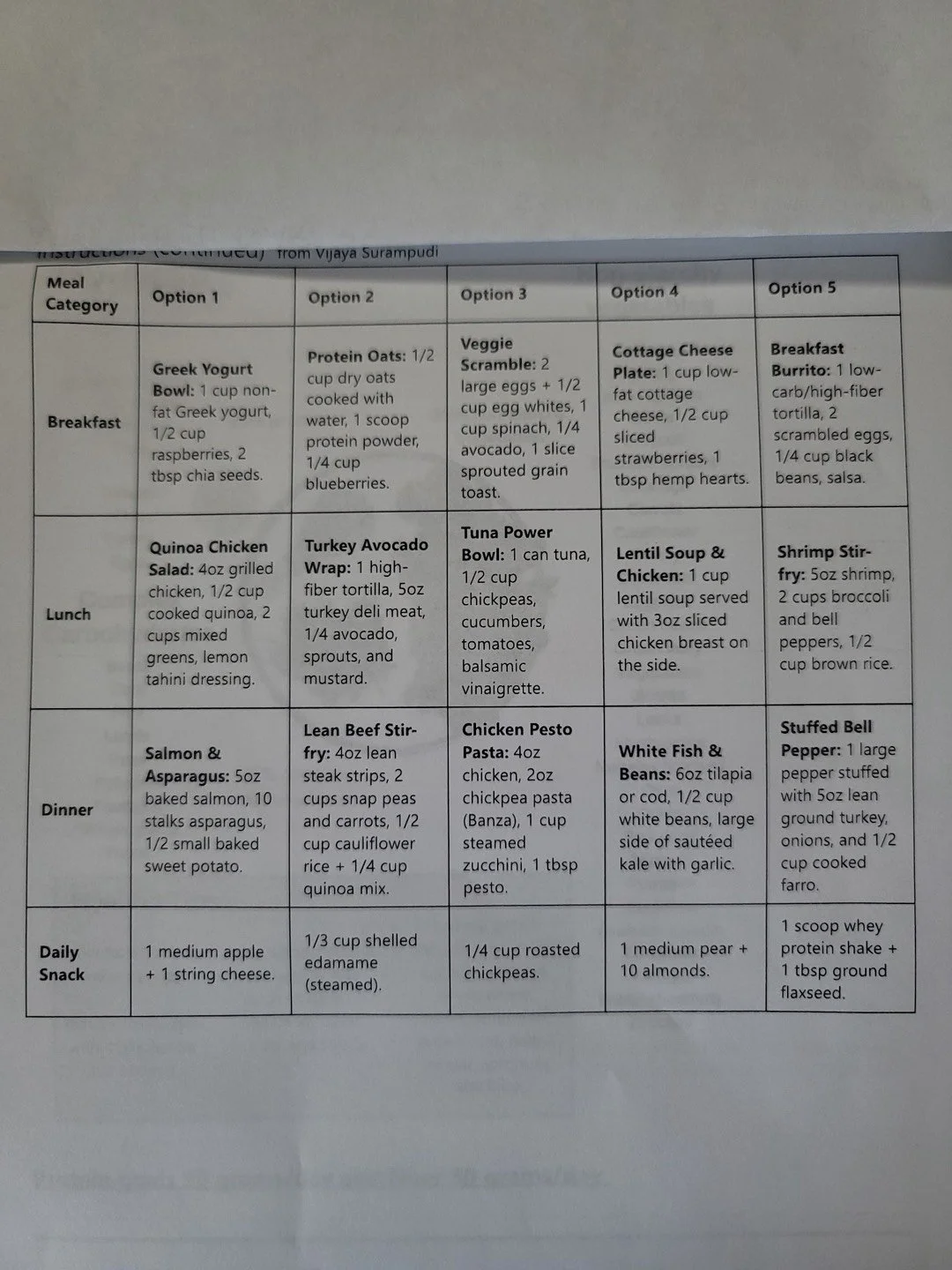
I’m looking forward to enjoying the wide variety of foods they’ve recommended. I’m not crazy about the Daily Snack list as there’s no chocolate. However, it’s only another month to achieve my goal so no time for letting up! Wish me luck!! And if you’re on your own journey to less, let us know how it’s going and what you’ve learned. Good luck to us all!