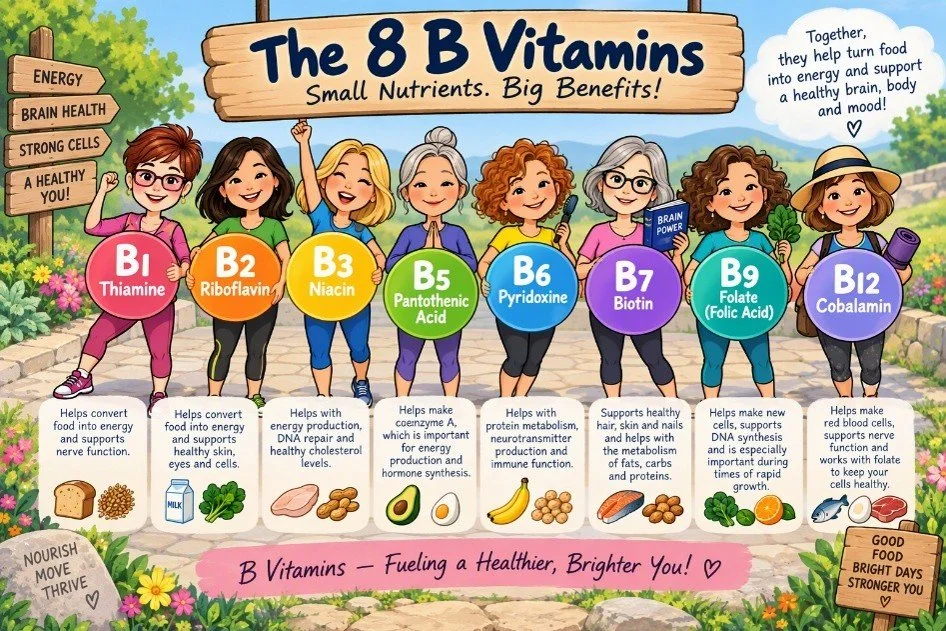
In our last blog, we talked about vitamin A. This week we’re on to vitamin B … all eight of them. I’m not sure who decided that A only got one and B got eight, but there you have it. Apparently the scientists who were studying and classifying vitamins put names on the vitamins before they really dug in to understand how different vitamins all are. And, to make it even more confusing the vitamin B labels don’t have an orderly 1 through 8. The scientists skipped or deleted some random numbers and so we have 1, 2, 3, 5, 6, 7, 9 and 12 in the vitamin B family.
In general, what do the B vitamins do? They play a key role in cell metabolism, energy production and the formation of red blood cells (RBC). Think of them as a metabolic spark plug that unlocks energy from food. If you’re eating less on your journey to less, be aware that a deficiency in your vitamin B intake can actually lead to intense sugar cravings. Maybe that explains my chocolate cravings??
Every B vitamin has different functions and non actually do all 3 functions described above. For example, B12, also known as Cobalamin, is the only one that specifically is needed for healthy red blood cells, nerve function and DNA production. Therefore, B12 seems like it might be the most important B vitamin.
However, vitamin B6 supports brain development, immune function and protein metabolism. Whereas B7 helps us metabolize cars, fats and amino acids making me think I should increase my B7 to avoid further hair loss?? Each of us has to decide what’s the right amount.
Vitamin B is quite different from A in that B is water-soluble. Because this whole series of B vitamins dissolve in water, our bodies generally cannot store B vitamins. They get eliminated on a daily basis through our urine. The only except is B12 which can be stored in our liver for a very long time, up to several years. For the rest of the B vitamin series, it’s important to take the right amount pretty much on a daily basis.
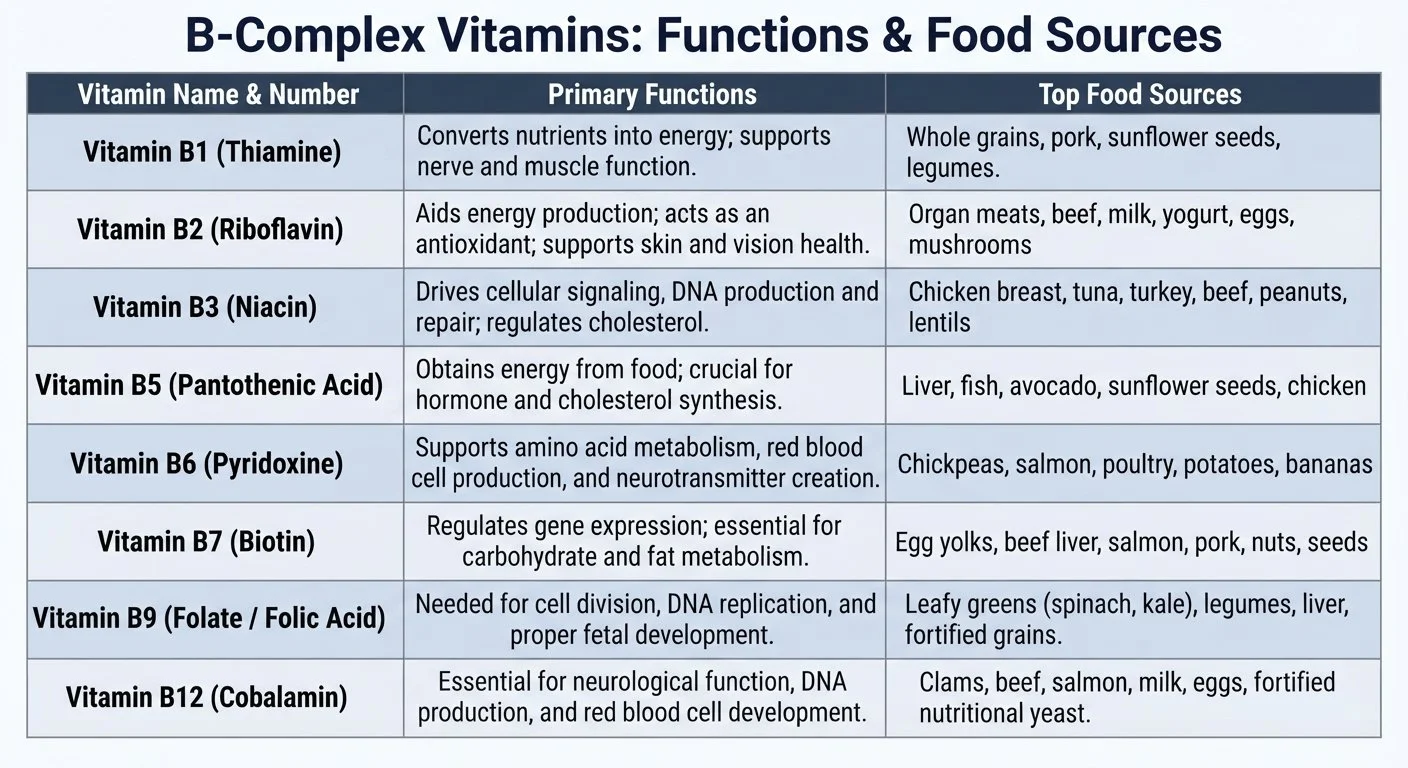
One of their critical functions is to convert food into energy. If you have a B deficiency, your body will be much less efficient at getting energy from your food consumption. On the other hand, too much of certain B vitamins can be harmful to your health. As with all vitamins, finding the right balance between too much and too little can be a challenge. And to make it even more complicated, there is no one food that provides all of the B vitamins. Below is a table that gives you an idea of what each of the B vitamins does and what food source is good. Thank you to the Cleveland Clinic for this table.
Here’s another helpful table. This one is from the National Institutes of Health. I was curious about how much of the various B vitamins is recommended for daily consumption. Interesting that the amount recommended varies hugely between the 8 B vitamins. Remember that “mg” = 1/1000th (one-thousandth) gram and “mcg” = 1/1,000,000 (one-millionth) gram. For vitamin B12, you could get the RDA from a 3-ounce serving of tuna. This table has the number, common name, Recommended Daily Allowance and Key function for the 8 B vitamins.
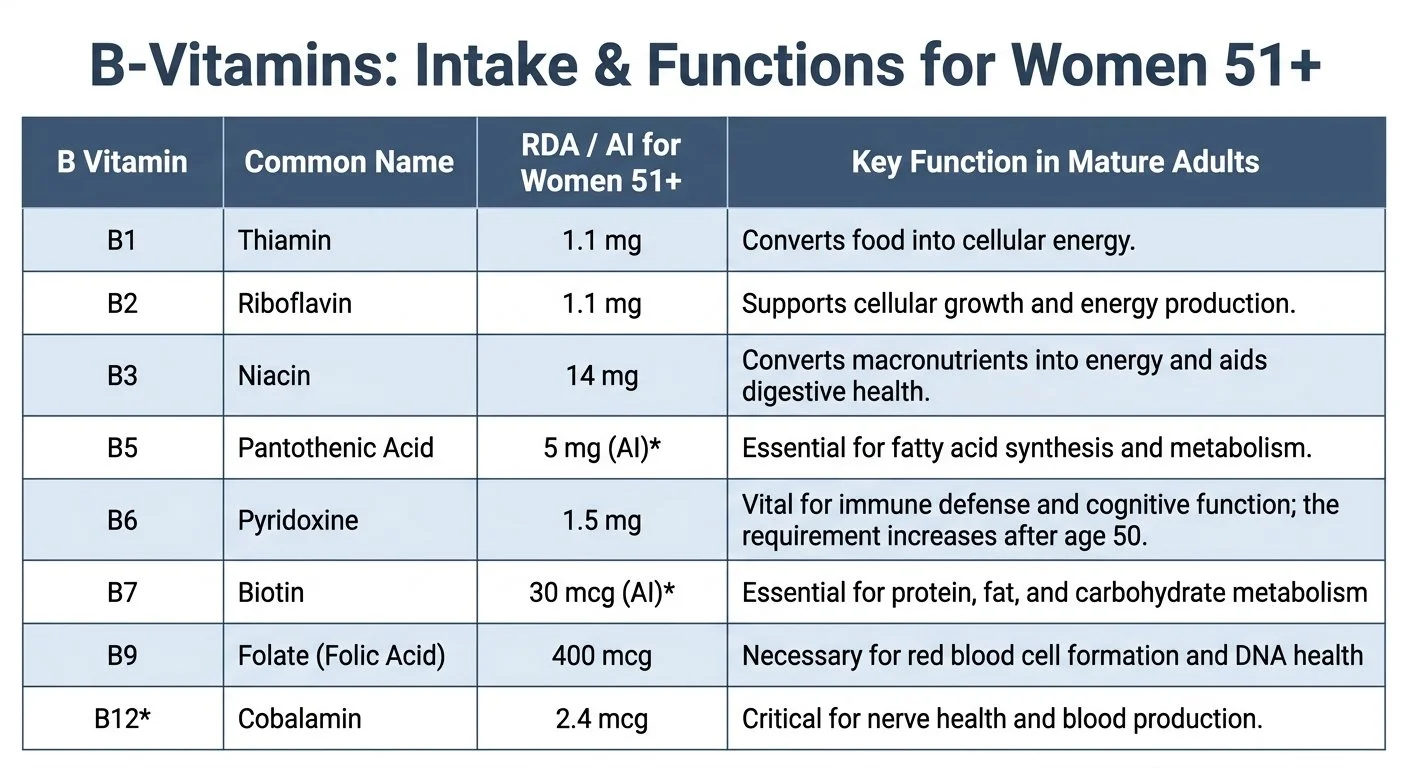
*Important note on Vitamin B12. If you are over 50, it is likely your stomach acid has decreased so you may need to get your B12 either through fortified foods or a B12 supplement. Please consult your medical expert for further guidance. ALSO! In the prior table, B12 is indicated for red blood cell development and in this table, it’s listed under B9. In reality, you need both to avoid anemia. So plan to have something like a lovely 3 ounce serving of salmon along with 1 cup of steamed edamame for both B9 and B12 requirements. In lieu of the edamame, you could swap out 1 cup of cooked asparagus along with ½ avocado.
I’ve mentioned that some of the B vitamins are unhealthy if taken in too large a quantity from supplements. Those culprits are B3, B6 and B9. They each have different negative effects so if you’re taking a supplement, watch for those 3 in particular. Of these, B6 seems to be the most notable culprit. When taken to excess B6 (pyridoxine) can lead to peripheral neuropathy. In English, that means nerve damage can occur which causes numbness or burning in the hands and feet. No one wants that! Let’s pause a moment and remember that the B vitamins are water soluble so our bodies are pretty good at flushing excess quantities out. Damage such as I described above tends to happen when there are massive overdoses over an extended period of time with insufficient hydration. Don’t do it! Just, don’t do it.
Here are the key B vitamins for anyone trying to lose weight:
Vitamin B1- Converts carbs into usable workout fuel rather than storing them!
Vitamin B5 - Supports adrenal glands to manage cortisol (linked to belly fat)
Vitamin B6 - Helps produce mood regulators and curb emotional eating
Vitamin B12 - Helps keep red blood cells healthy to fight deep fatigue
For a bit of poetic fun, I asked Google’s AI to create a short poem for you about the role of each B vitamin. Below are the results. I think human writers are safe from competition from AI, but it was fun to give it a try!
The Busy Body B-Team
B1 takes your food and ignites the spark,
While B2 makes sure your metabolism hits the mark.
B3 helps your cells talk and fuels the brain,
Keeping your skin glowing and your energy sane.
B5 (Pantothenic) is building up cells,
While B6 (Pyridoxine) rings mood-boosting bells.
B7 (Biotin) makes your nails long and strong
,And B9 (Folate) helps DNA cruise along.
B12 builds red cells to carry the freight,
Ensuring your nerves never miscalculate.